Category: Other

  • When your teeth hurt… you know it was a proper crash!

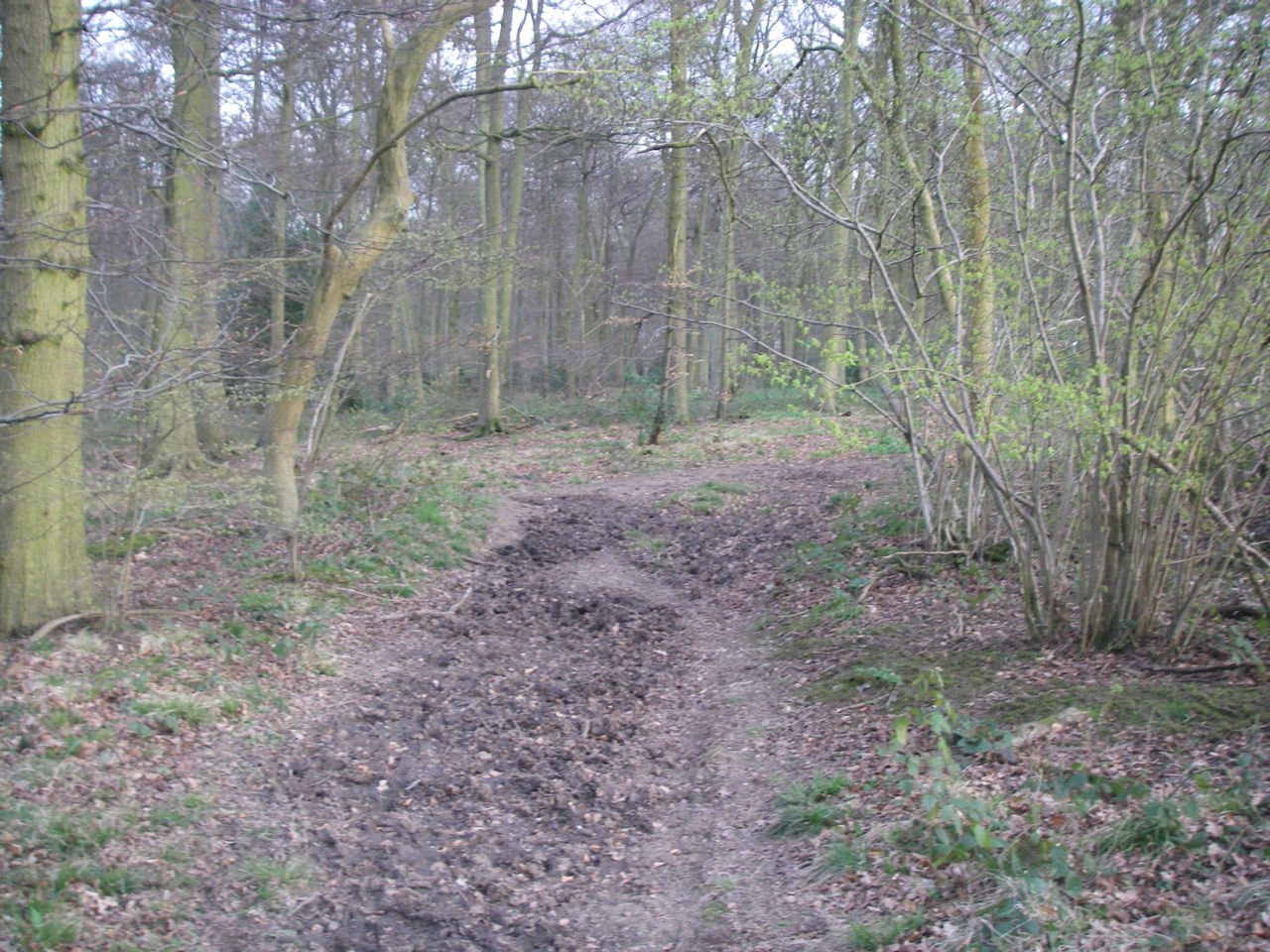
    One of the things I really appreciate about mountain biking is that there’s nowhere to hide if you’re not up to it. If you get things wrong, there’s no “deferred success”, no letting you down gently. You don’t “not pass”, you fail and there’s just the smack of you hitting the dirt. That was how last night went:

    Work had slipped into the way again, and I set off late. I had deliberately eaten a light dinner in the hope that I could ride light, but that was too long ago. Even on the way to the woods, I was thinking that it could have been better to stay home. But it felt like a ride that had to be done. Even in the first corner, my bike felt like a sack of spanners. Rattling over bumps, dropping the chain, spanging over the roots, everything was disjointed. With my new bike expected the next day (today!), I resented this machine. I lacked flow, and it responded in kind.

    I was here to ride though, so I hit the Full 9 Yards as hard as I could. It has some great fast sweeping corners that can usually flatter your riding. They mocked mine. I wasn’t as fast as fast or as precise as tidy. I carelessly jumped into a left-hander, and my back wheel clipped a small tree-stump mid-air. In the next moment, I was on the ground. My bike tumbled down towards my back and I redirected its fall into the bushes. I was dusty and hoping that I hadn’t broken ribs again. As I sat there, my teeth hurt. So I must have hit my face on the ground. Everything seemed to work ok though: some grazes and a bruised thigh. The bike was fine. So I got back on and limped up the hill.

    The rest of the ride was taken at a jog and that’s not something I’ve done recently at Swinley. Suddenly, I could see all kinds of things off the trail: the trees and the deer, the sinking sun and the needles on the ground. It was nice to really feel the corners without trying to go quickly. It reminded me of that feeling you get when trying something new at swimming. I could feel the trails as I could sometimes feel water caught under my hand.

    And as I rode, my iPod shuffled up some reminders of the near future. Both Josh Ritter’s “Other Side” and Steve Earl’s “Fort Worth Blues” mention The Great Divide. As if I don’t spend enough time brooding on it already!

  • All the usual troubles (and some success!)

    I hate whiny blogs. So there were no posts for a while as I tried to sort things out…

    Trying to do a big event always seems to push everything else harder. It takes so much time and energy that wrinkles in everyday life seem like mountains. And holes in the plan for the event seem like dark chasms. So while my attempts to reduce my load at work are still coming to nothing and I often have to work until midnight after training; and while the frame that I was going to use for the race is broken; and while my knee has been hurting again; these things are not insurmountable.

    The work will do what it does and if some things fall by the wayside, I’m going to try to accept that I can’t do it all.

    The frame will be replaced by something different and better, but more on that when it’s done!

    And the knee still feels odd but doesn’t hurt today. I’ve taken some rest, moved my cleats about 1mm – it felt better, and I’ve been riding with flats for commuting. It’ll get there.

    The fortunate side of the knee is that it has given me time to nail down those last few bits of gear (aside from the new bike!). I got myself a new 500g tarp recently which isn’t ultra-ultra-light, but it’s light enough for my budget. With the tarp and my bivvy bag, I’m ready for anything. If it’s dry and warm, then I can just use a sleeping bag. If it’s wet and warm and I can find a way to pitch it, I can use the tarp and sleeping bag. If it’s wet and cold and I can find a way to pitch it, I can use the tarp and bivvy. And if it’s wet and cold and there’s no tarp possible, I can survive a cold wet night in just the bivvy.

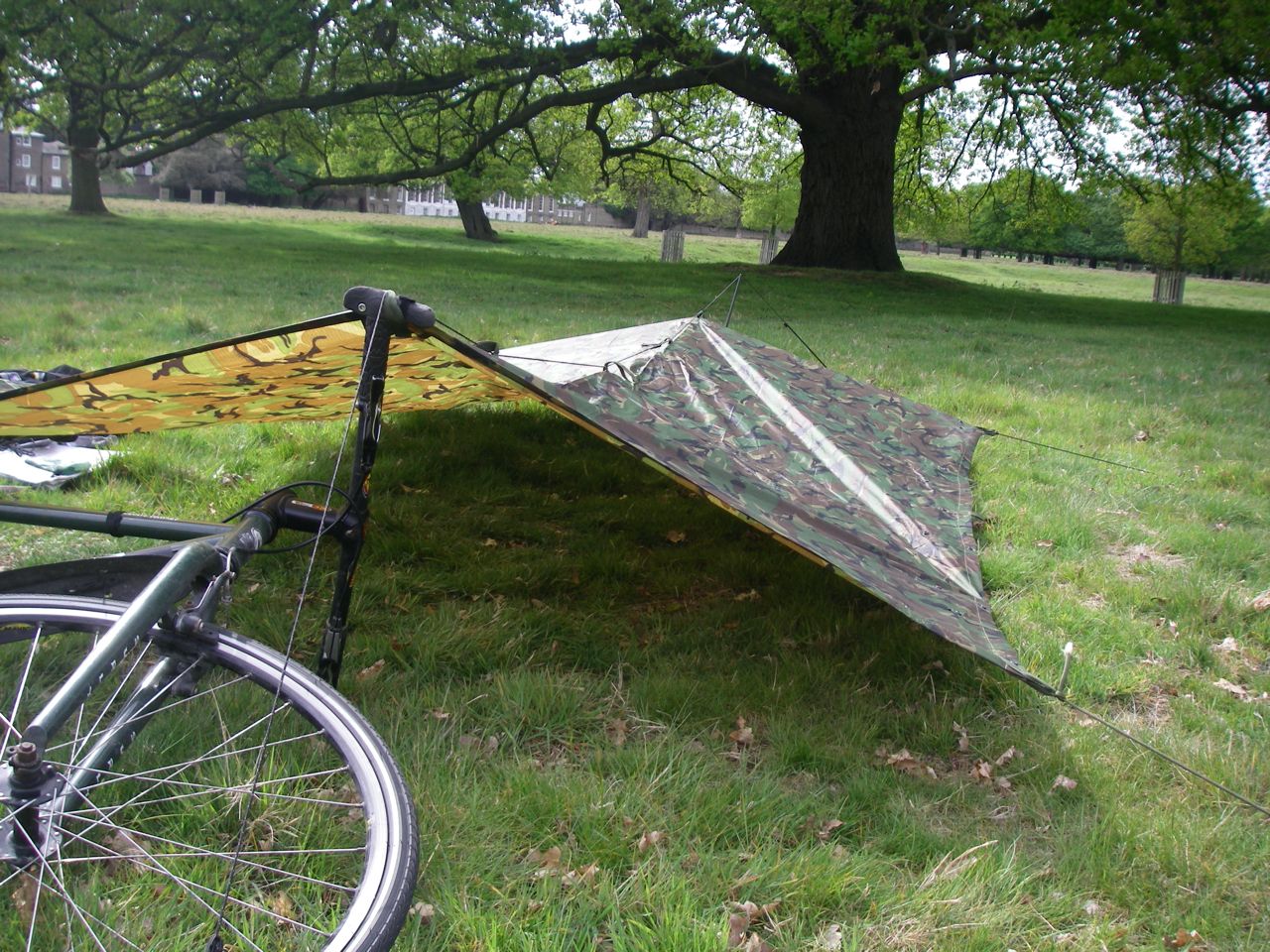
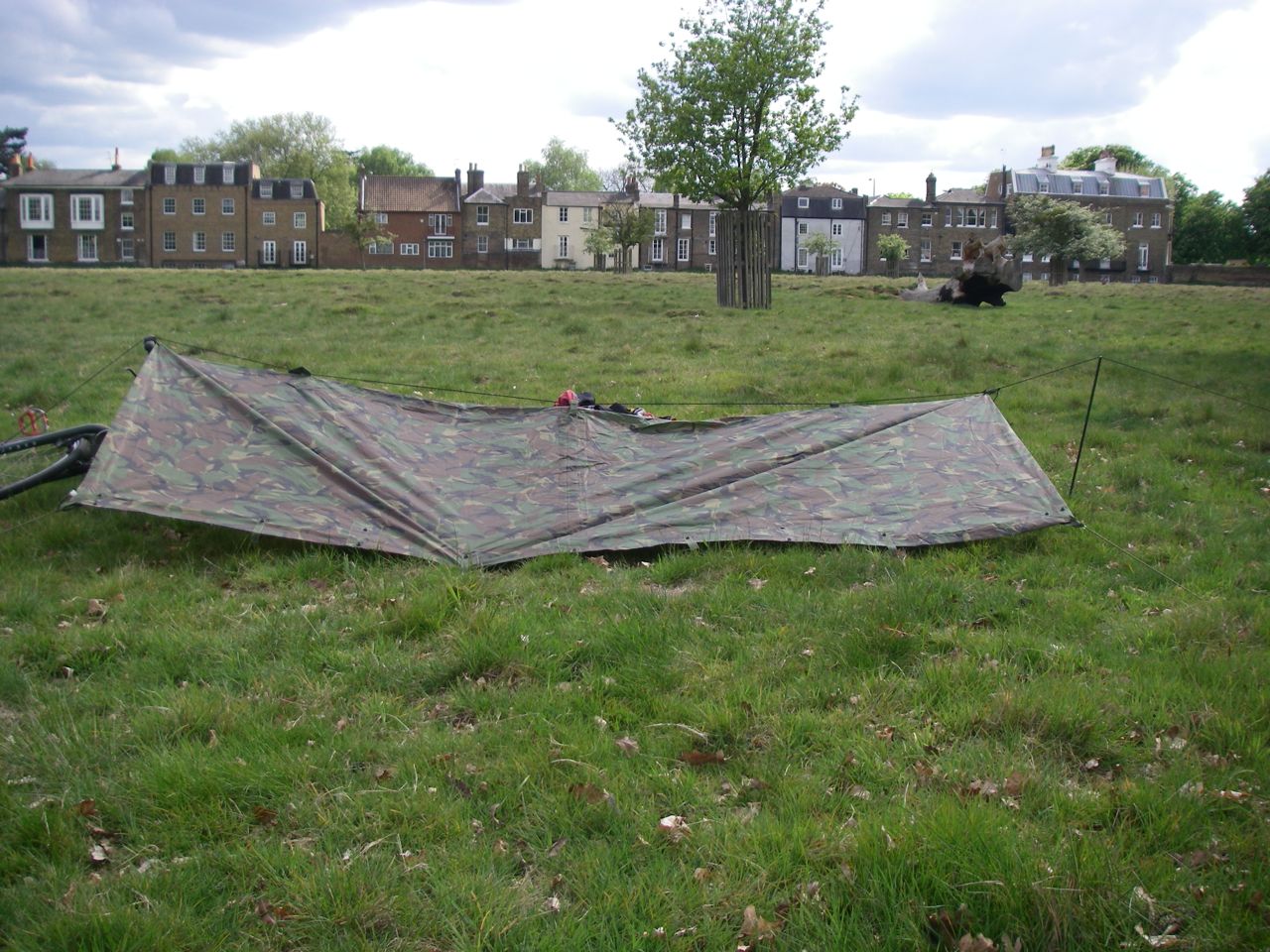
    So, today I cut a slot into a carbon pole that I had lying around and tried pitching the tarp using just the bike and that one pole:

    Pretty successful (the funny wrinkle in the side is due to only partly pegging that side in). It’s wide enough to lie under with gear. It’s high enough not to be right in my face. And if I can find co-operative branches or trees, it could be even better. The pole can easily attach to the bike with velcro cable ties, and the same ties can be used to run a guy rope across the bar-ends. Sweet!

    So it’s back on the bike tomorrow and crossed fingers that the frame damage won’t damage me!

  • Creating a new normal

    I often think of training as being a process that shifts my idea of what’s normal. At the moment, going out and doing 70-100 mile rides every weekend seems normal. “Normally”, that’s not normal.

    The new normal I’m going for now is doing the same rides, but on a loaded bike. I’m working towards getting my Tour Divide setup ready and it’s now close enough to be riding with the full weight every time. My plan this time is to use a big drybag under the handlebars and an Epic Designs saddlebag out back. And that’s it – no hefty pannier racks, no frame bag.

    It’s been worrying me a lot that I won’t have the legs to singlespeed a loaded bike with a reasonable gear ratio. For the Alaska Ultrasport, I had a 22t ring up front. That’s OK for snow, but it’s not going to get you anywhere on the Tour Divide. And I might be able to do 100 miles without being too trashed on my 32:18 XC bike, but what if it weighs twice as much?

    Today (swapping work days around since I have to work Saturday… boo!), I found out. With 12 kg of extra stuff on my bike, I set off into the Chilterns again. I tried not to put any pressure on myself – I expected it to be slow and difficult. I expected descending to be sketchy. So I thought I’d have a go at 6 hours, maybe 8 tops.

    Throughout the whole ride, though, I felt that burden. If I couldn’t do this, the Tour Divide was a pipedream. I had to keep deliberately relaxing my upper body – not letting tension sap my energy or cause injury. The sun shone and the first hour and a half passed incredibly quickly. I was eating up the miles way faster than expected, averaging over 11 mph in hilly terrain. I was winching up climbs when I would usually try to dash up them, but that wasn’t a problem. The top is the top, and the GPS wasn’t lying about my speed.

    It’s a funny thing riding with a big saddlebag. It feels like being a dog with a massive wagging tail. Occasionally, it can get too excited and the tail starts to wag you. Then you’re in trouble. But part of the point was to learn these things. Climbs were steady, keeping any side-to-side movement out of the equation. Descents were interesting until I learned to keep the saddle pressing gently on my thigh. This seemed to dampen the wagging and keep me where I wanted to go.

    By the end of the ride, I’d reached 30 mph on a descent and felt comfortable with the handling. I’d carried all the food and water I’d needed for the day. And most importantly, I wasn’t broken. Maybe this Tour Divide thing will work out…

  • What to eat?

    Food is pretty vital to riding. In the Alaska Ultrasport last year, I made a bit of a mess of it. As people pointed out (too late for me, unfortunately!), I had gone too far down the path of the spreadsheet. I calculated calories per gram, and stocked up with large bulks of the foods I thought best fit that criteria. Taste was a factor, but I got lazy and just bought a limited range of food.

    On the trail, that sucked. I didn’t want to eat my high calorie food. I wanted someone else’s high calorie food (luckily I could trade with other racers now and then). So the lesson was learned. Variety! I spent lots of time reading the backs of packets of food that could work on the trail. I’ll take all kinds of stuff next time.

    Back in the “real” world, training in normal temperatures still needs a lot of food. I had always avoided energy products: they were expensive and, somehow, just as suspect as using gears. Like I wrote before, though, things changed and I started using powders.

    Initially just Maxim, since we had some from Emily’s swims. Then, Torq, since it’s tasty and well-regarded among cycling people. Suddenly, I could get a lot more energy into me during a ride and felt a lot less soreness on the long ones. I could keep pounding out miles with less deterioration on the bike and quicker recovery afterwards. So energy drinks are effective, but are they expensive?

    This calls for a table!

    Calories/g p/calorie normalised p/calorie %fat
    Malt loaf (large BOGOF) 3.1 0.07 1.43 2
    Torq Energy (1.5kg) 3.6 0.29 5.86 0
    9-bar (3 pack) 5.5 0.14 2.79 40
    Torq Recovery (1.5 kg) 3.48 0.59 11.8 1.1
    Panda licorice comfits (132g) 3.7 0.27 5.49 0.2
    Mars bar (3 pack) 4.46 0.13 2.6 17.4
    Hovis Granary Bread (2 for£2) 2.5 0.05 1 2.4
    Nairns Oat Cakes (250g) 4.18 0.09 1.7 16.3
    Beer (average) 0.43 0.88 17.58 0

    So, Torq Energy is nearly 6x as expensive as bread and Torq Recovery is 12x. But while this table is interesting (hmm) it doesn’t tell anything like the whole story. The energy products are easy to get in you, and well balanced to have their positive effects. I can say quite categorically from my experience that they help. I’d just suspected that they weren’t so much more expensive than normal food. It turns out I was kind of wrong on that point (unless you drink beer as your recovery drink – that makes Torq seem cheap).

    I’m going to carry on using them, for sure. But now I know I’m paying for the privileged. For the record, my last 10 hour ride took 2 bottles (750ml) of Maxim, 3 bottles of Torq, a malt loaf, a pack of oat cakes, and a 9-bar. Immediately after finishing, I swigged down a dose of Torq recovery. End result? I felt pretty good despite doing nearly 100 miles, having two punctures and one other mechanical. And I took a photo:

    Not suitable for motors, definitely suitable for bikes.

  • Seasons

    The makers of the mountain bike video, Seasons, probably didn’t think of me slogging around The Chilterns when they came up with their concept but I did think of them as I photographed the same corner in a succession of seasons. To me, it says a lot about riding in the UK. We go out whatever the conditions, and the conditions give use plenty to get our heads round. The mud and the water grind away at bikes and wear through clothing, but give us beautiful green land to play in. They make stolen late-Autumn dust feel precious and the creep of Spring feel like a blessing. So here’s an unremarkable corner of the Chilterns as I keep visiting it…

  • Big smoke, big ride

    When I was asked if I would teach a course in East Ham, it did seem like the ideal opportunity to get some base fitness going again after NZ. The ride over there is 25 miles and gets interesting at Battersea as it ploughs through central London, crossing Tower Bridge, before heading out via Tower Hamlets and Stratford.

    Now, I’ve been regularly commuting by bike for 10 years but never somewhere like central London, and it’s a bit of a shock. As you head in, and the traffic starts to clog, there is no point whatsoever in waiting in line. Those cars are going to be nose-to-tail for the next 15 miles. So, you want to duck inside or out and get through. But it’s not so easy, the place is swarming with motorbikes, scooters, and other cyclists trying to do the same.

    Much looking over the shoulder is required, but it’s fun cruising past the cars on the wrong side of the road. The sheer number of cyclists is completely alien to me, but normal to them. There are no nods of acknowledgement. People pull up in front of you at traffic lights (if they stop at all). Riders take offence if you overtake, and ramp up speed to try to hang on behind you. I took away a sense of hostility from the week of riding across London, and most of it came from the cyclists.

    Still, it was strange how compelling the dance of the other traffic was every morning. The miles would fly by, the sights would be unnoticed. I would take risks that I could control (overtaking on the right) and shy away from those I couldn’t (overtaking moving traffic on the left). It had a kind of buzz, and day-by-day my times for the ride went down.

    The evenings were better, though. I left the school by 3.30, so the traffic hadn’t hit its peak. I didn’t have a deadline to get home (except the increasing debt that I owed my stomach), so I could finally look around. The Gherkin would rise up ahead of me MIND THAT BENDY-BUS! and I would cruise off down a quieter road. The blue supports on Tower Bridge would embrace me and I would watch the tourists spin around, whirring their cameras as I whirred my pedals. Hospitals and hair-dressers, I could glance at little scenes all over the city. Harlequins Rugby Club would always be busy and signal that I was nearly at Kingston and from there, nearly home.

    In the middle of it all, there were surprising moments. Cars giving way without need (people outside of London may find that unremarkable, it can make your day down here), and just when I was tired and jaded, another cyclist. He set off up Kingston Hill in front of me, and I tucked in behind. I hoped he wouldn’t get annoyed about towing me up the hill, but as he pointed out a pot-hole, I knew he wasn’t cursing me. Both being red-light stoppers, we had a good chat about riding. Where we’d been (on the same road for more than 10 miles), and where we were going.

    Where I was going was back to ploughing my usual furrows and to speculate on whether more cyclists is really a good thing. In the outer boroughs of London, I see almost no other fast-moving bikes. If we get the change we’re trying to bring about, and more people do cycle, I hope the combativeness of the centre doesn’t set the tone for all cycling in London.

  • The Kepler Track

    There are a number of “Great Walks” in New Zealand, and it had been our plan to take in a couple while we’re out here. The Kepler Track (yes, physics fans, that Kepler) is a 60 km track in the Fjordland area of NZ that starts near Te Anau and takes in lakesides, forests, rivers, and alpine areas. It climbs from sea-level up to 1472 m at the top of Mount Luxmore. Here in NZ they call hill-walking, “tramping”. Which still tickles me. Tramping has 3 association with me, only one of which is remotely appropriate: homeless people drinker super-strength cider under bridges; Supertramp, the band my knowledge of which comes exclusively from The Simpsons; and Alexander Supertramp, the name taken by Christopher McCandless in Into The Wild.

    What’s strange to someone like me is that you must make reservations at the official campsites (and pay for them) before setting out. I tend to side with Ray Jardine on this topic – minimal impact camping is best achieved by responsible wild/stealth camping. Official campsites make you pitch on bare hard ground that’s had hundreds of tents on before. They put you shoulder-to-shoulder with people who pack beer and noise into the wild. They almost encourage littering by giving the impression that someone will pick-up after campers. And they concentrate toilet usage, causing a larger impact. Camping alone and leaving no trace seems infinitely superior for those who can, but this time we went along with the grain and paid our fees ($15 each per night!).

    Rant over, we took to the trail mid-afternoon at “Rainbow Reach” – a swing-bridge access to the trail that gave us ambitious but achievable mileage targets each day. It’s a lot of fun to set off with everything you need for the next 2.5 days on your back, and we whizzed along happily. The trail was very well groomed and marked, following along the river but taking ups and downs now and again. We walked in the gentle green light that filtered through the trees and were glad of the protection from the sun. Despite NZ’s reputation we have had weeks of unbroken heat and sunshine!

    I’d packed my gear pretty light with no changes of clothes, only a few extras to put on top if the weather did come in. Food-wise, however, we’d gone for luxury. On the Alaska Ultrasport I had made the mistake of judging food too much by calories per gram and not enough by variety and taste. This time I was going to use the relatively short trip and kind weather to experiment with going the other way. We packed pre-cooked flavoured rice with seeds to be added, tortellini in sauce (rubbish calories per gram, great taste so great for improving your mood). I had muesli bars, corn chips, and licorice (vegetarian alternative to outdoor staples such as Jelly Babies or Haribo) as snacks. So meal times were fun and pack-weight-shedding.

    Our first camp-site was Brod Bay, on the shores of Lake Te Anau. We were glad to dump our food-heavy packs and cool our feet in the water. This was, however, our first introduction to sand flies as a scourge rather than a nuisance. They are stupid weak little creatures that can drive you completely mad. They fly so slowly that they can’t keep up with walking, or overcome anything more than a gentle breeze but, when they do catch up with you, the bites swell up and itch for days. They’ll go for any exposed flesh: hands, feet, face, lower back if you’re sat leaning forward. Complete buggers.

    Despite the sand flies, though, we had our tasty dinner and soon dropped into conversation various other “trampers” at the camp-site. It turned out that there is only really one schedule around the Kepler Track if you want to stay in camp sites instead of huts (expensive). So, we had our first of many meetings with (I’m terrible at names the first time) French-Canadian Couple, their French Friend, and Super-Speedy Guy. All of which we’d see in camp and on the trail for the next few days. I had to admire French-Canadian Couple’s tarp skills, and they turned out to be very friendly.

    Tent-wise, Emily and I were back in my 1+ racing tent i.e. practically on top of each other. As I started to put it up, though, a problem emerged. Some essential stitching had come out and one end of the fly was unsupported. To make matters worse, for once in my life, I had no gaffa tape! Eventually, I figured out how to bodge the tent, leaving one end of the fly open, but the rest of it reasonably secure. Getting in, we performed what was to be the nightly ritual on Great Walks – lie down and relax while squashing all the sand flies that came in while you did. Mmm… romantic!

    Day 2 took us all the way into the Alpine section of the Walk and up to the top of Mount Luxmore. We set off pretty early with minimal faff and it was a blessing to get a good deal of the 1000m of climbing out of the way before the full heat of the day. Switchback followed switchback, and the effort spent in building this track was clear as we crossed bridges over high drops and occasional steps up the rock faces. Emerging from the trees onto open dusty landscape of the tops, we could see scenic bush-plane flights below us and Te Anau far away. Seeing the trail wind ahead, it was like I had been transported back to the PCT but this time with more knowledge and no crippling knee pain.


    We wound around the peaks and ridges, along the heat of the day. Things were going well and we dumped our packs for the diversion to the summit of Mount Luxmore where we found Super-Speedy Guy making a cup of tea. We’re English, that’s our job! Continuing along the trail, we were to follow the tops for a while before descending down to camp by the river at Iris Burn. I experienced the slow magic of walking once more as the far off features sneaked forward imperceptibly. These slow movements would be punctuated by sudden transitions, as I realised that I was standing on the far-off peak which had seemed so distant.

    Coming down, the construction of the trail was, once again, apparent. Steps took us down quickly and easily, only to hand over to an unbelievable number of switchbacks down to ground-level. By camp-time we were both well-finished for the day, and had a nice dinner with French-Canadian Couple. Early nights are easy when you’re walking all day and we were in bed before nightfall.

    Day 3 was back out along the river and aptly summed up by a Korean tramper we met. We asked him if he was enjoying the trail, and replied “Here it is boring and too long”. To tell the truth, it kind of was. The river-following terrain was just as in Day 1 and our tired feet really just wanted rest but had 6 hours of walking to beat out. As we got closer to Rainbow Reach, though, we started to see fresh-faced day-trippers with small packs. This was a good sign, but I carefully managed my expectations. If someone who has just come from their car says it’s 5 minutes away, don’t believe them. You’re not there until you’re there, and I didn’t let my feet anticipate release until I could see that final swing-bridge. It did come, though, and we had made it round 60km in about 2.5 days of tramping. We hadn’t seen an awful lot of animals, but we had met some characters and seen some views.

    To put some humbling perspective onto it, consider The Kepler Challenge. An ultra-marathon around the same track that we walked where (locals tell me) the record is 4 hours. Unreal.
  • Like Wales, but bigger

    A few days into New Zealand and we’re getting things done. We bought a van…

    We had a swim…
    And I did some kayaking…

    It’s odd being in a foreign country with our own Queen on the banknotes and where cars still drive on the left. Kiwi hospitality has been just as exceptional as people say it is: from the hostel (Kiwi Basecamp) owner in Christchurch helping us to choose the van, to the kayak rental shop (Captain Hector’s, Akaroa) giving us a great deal on the kayak in order to help Emily’s swim, to friends welcoming us in at Dunedin.
    The van is a Toyata Previa. A people carrier. And I don’t have 7 children. Oh, well. It has the back converted into a comfy bed, and it goes when it’s supposed to so I can’t complain. NZ has a real campervan culture – there are loads of them out here. Rentals, tourist-owned, and local-owned. So many people want them for touring here that there’s a whole market of buying cheap vans for a few weeks or months then selling them on. We plugged into that market to get ours, and will hopefully sell it in Auckland before we go.
    Our first stop was Akaroa, a small town on the volcanic Banks Penninsula. It sits on an outrageously blue harbour and serves pastries under the Tricolore, proud of its French heritage. As we drove down through the clouds, the whole area had a low grey ceiling. The harbour looked more like a large lake than a sea, and a 6 hour swim for Emily was on the agenda.
    Jetlag and necessity had us up early and into the water for 7.30. The swim began with a walk across the silt left shallow by the tide. Eventually, we could swim though and the cold was enough to tweak at a few muscles. Not enough to numb my face though, so maybe 15C. We swam across the harbour and around a little cove where a boat had anchored. On this side, the land dropped steeply to the water and trees hung onto the green slopes.

    The plan was to swim back to the car, then I could go pick up a kayak and join Emily for the rest of her swim. So, I loaded up, thanked the guys at Captain Hector’s and headed out. We plotted a route around the harbour and the cloud finally lifted the lid on the day. With peaks and ridges all round us, and blue water underneath us, it was great day to be out and the wet bum caused by the “self bailing” (for which, read, self-filling) kayak didn’t seem like too big a problem. The swim flew by pretty easily, punctuated by the sight of rare Hector Dolphins at on stage. Their fins did cause a brief heart-stopping moment, but I quickly recognised that they were the local dolphins not sharks.

    Our next plan is to hit the Kepler Trail for some hiking, and then Doubtful Sound for some more kayaking. No bikes 🙂
  • It’s bike failure season, so lets sleep out

    There’s always a time of year when my bikes all start falling to pieces. It’s come now, just as I was getting over a Christmas-acquired cold and disrupted my plans to get some good training in for the TD.

    The current bike casualty list is:

    • Stuck front brake piston on Pugsley
    • Worn out BB on Pugsley
    • Worn out rear wheel bearings on Karate Monkey
    • Worn out freewheel on Karate Monkey
    • Worn out rear tyre on Karate Monkey
    • Worn out pedal bearings on Karate Monkey
    • Broken cranks on Balfa
    • Worn out pedal bearings on Balfa
    • Torn (but patched with toothpaste tube!) tyre on Voodoo
    • Worn bushings, and associated gouged stanchions on Voodoo’s forks
    • Worn out pedal mechanism on Voodoo
    • Mangled LH crank-arm on Voodoo
    • Broken saddle (might be fixabled) that I use on Voodoo/Pugsley

    Woe is me! I’m sure I can beg, and ebay my way out of that lot eventually.

    Fortunately, this weekend is time to go to NZ for Emily’s swim which means a break from bikes. We’re going to buy a camper van (and sell it before we go) to tour around the country swimming, kayaking, hiking, (maybe a bit of biking), and having a fine old time. So with this and other camping adventures in mind, we’ve been testing out various combinations of gear…

    Where some people see -5C in London as a problem, we saw an opportunity for Emily to test a potential new sleeping bag and for me to push the envelope with minimal gear. Camping out on the grass by the pool where she works was an odd experience. We headed out from home at around 9pm (just when we were warm and settled for the night), and picked our spot on the grass. Somewhere without frozen footprints so that we could make our own smooth ground. Up with my tent for her, and down with my bivvy bag for me.

    My aim was to see how my +7C rated summer bag would perform when wearing cold-weather clothing that I might take on the TD. For the uninitiated, a bivvy bag is a breathable waterproof outer shell to put a sleeping bag in. It looks like a green body-bag, but gives you an acceptable level of protection for just 300g. Point number 1 was that my sleeping bag zips up on the opposite side to the bivvy. Tricky, but not insurmountable. Point number 2 was that when it’s cold, you need to do it pretty much all the way up which is pretty claustrophobic, but that’s something to get used to.

    To be honest, I don’t think I slept at all that night. City noise and uncomfortable (but not dangerous feeling) cold added together to keep me restless. I knew that I wasn’t warm enough and doubts nagged about whether it would do any harm. My mind jumbled and circled possibilities, but wouldn’t rest. I suppose the conclusion is that if -5C is the extreme end of what I could expect on a trip, then the kit is just enough.

    Camping out like that probably seems even more insane to some people than going to the great outdoors, but it’s a great way to test stuff with no real risk and a way to get a tiny slice of being in the wilds without having to drive way out of London.

    It was the same mentality that I took to Wales at the weekend. The plan was to ride all the trails at Afan in one go, then sleep out and head to Barry for a meeting on Monday morning.

    Starting from Glyncorrwg Ponds, the trail is 4 miles of twisty climbing. It was immediately obvious that lots of time on a turbo trainer is good for sitting down on moderate inclines and not that helpful for hauling up a proper hill with one gear. My arms were still attached at the top, though, so I made it to the fire-roads.

    I had known that snow was a risk, particularly on the more remote Skyline trail and as soon as I dipped away from the main valley, I was on a mix of snow and ice. Wet snow ploughed my tyres sideways. Polished ice drifted me around with disdain. Pretty soon, I was walking through ankle-deep snow in my summer shoes. Frustrating as it might have been, I had my long-ride head on and this could easily be replicated in the Rockies in June so I took it for what it was.

    After some getting lost, I eventually found the trail markers again only to find the trail gone. Logging by the forest owners had obliterated sections of trail completely, forcing me to carry over and around. Still could happen in the Rockies. I spied another rider ahead and he turned out to be a local who had worked on the trails. We dragged some of the more manageable stuff out of the way and he took note of what needed tackling with a saw. When I got back onto the mission, I had covered few miles and a lot of time, but I was coming back around to the trail centre.

    With fresh supplies, I headed out to tackle that silly climb again. As soon as I reached the top again, I noticed my crank-arm: still bolted tight but the spline had worn round and it was pretty close to going round without the axle. The only safe thing to do was to pick a safe way down and abort the ride. Damn.

    With the ride aborted, I had time to think about where to sleep. Either a cheap hotel (below) or a bivvy.

    The beach at Barry turned out to be a great place for a bivvy. Quiet, dry, and with the chance of a nice sunrise in the morning. So, I settled down and watched the stars. As I lay there, they flew back away from the sea. Hang on… stars don’t move. My head churned, but the stars kept moving. I’m sure stars don’t move. I don’t look at stars often enough, but I’m sure they don’t move. Finally, my brain caught up and realised that it was the clouds moving. Shifting gear, I could suddenly make out a sensible perspective where banks of cloud drifted overhead. Shooting stars popped across my view now and again as I lay snug in my bag. This certainly beat TV in the hotel, and a perfectly restful night enveloped me.


  • Why eat malt loaf?

    Why eat malt loaf when you’re riding? Because it makes your spit brown, so you can pretend you’re a tobacco-chewing cowboy without having to chew tobacco. Now, where’s that spittoon? Zp-ting!